
Property Taxes: What You Pay, Why It Moves, and Who Else Is in the Room
Think and Act Locally · Deer Park · Piece 1 of the Topic Pass series. Every number below has a source you can open. The tags like [S3] point to the source list at the bottom. The same numbers, with where to find each one, are on the Council on Local Relations fact sheet.
What this means for you
Who cares? Every Deer Park homeowner. Every renter too, because your landlord's property tax is part of your rent.
How does this affect me? Picture a home worth about $289,000. After the discounts most owners can claim, the yearly tax bill comes to about $4,640. This is an example, not your bill. Your bill will be different. Look up your own number at HCAD's property search.
So what can I do?
- Check that your homestead discount is on file with HCAD.
- If you think your home's value is too high, you can file a protest with HCAD. The deadline is printed on your appraisal notice.
- Read what the City plans to spend: City of Deer Park budget.
- Read what the school district plans to spend: Deer Park ISD.
- Go to a budget hearing and ask a question.
New to this series? Read how we read the evidence first. It explains how we check our own work.
1. The bill
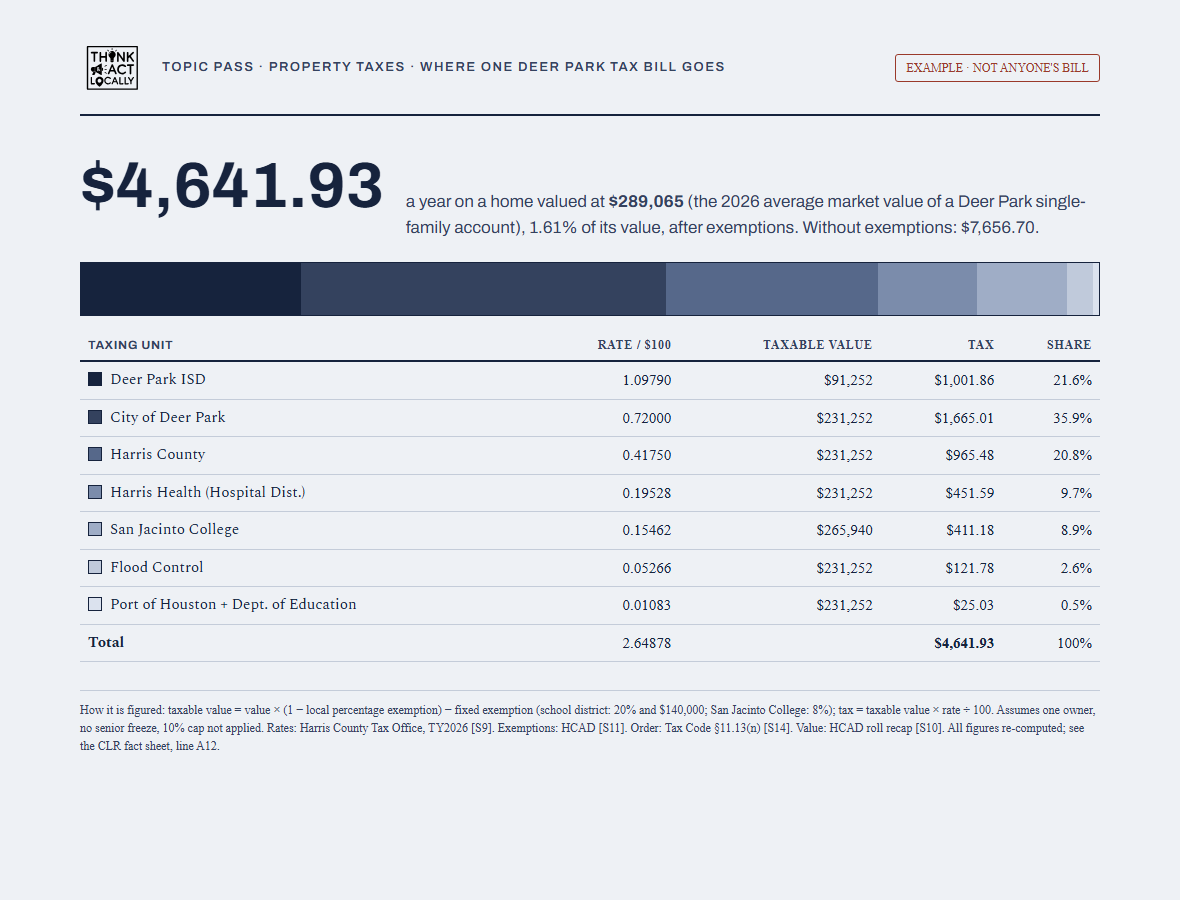
Your property tax bill is really several bills in one. A school district, a city, a county, a hospital district, a college and two county-wide districts each take a share. For tax year 2026, the rates are listed below. Each is per $100 of taxable value. [S3] [S7] [S9]
- Deer Park ISD: $1.0979
- City of Deer Park: $0.7200
- Harris County: $0.4175
- Harris Health (the hospital district): $0.1953
- San Jacinto College: $0.1546
- Harris County Flood Control: $0.0527
- Two small ones (the Port of Houston and the Department of Education): the rest
Add them up and you get $2.6488 per $100. The school district takes about 41% of that rate. The City takes about 27%. The County takes about 16%. All the others together take about 16%.
A worked example. Take the average 2026 market value of a Deer Park single-family home: $289,065. [S10] Each taxing unit gives a discount for the home you live in. Most give 20%. The college gives 8%. The state also takes $140,000 off the value for the school tax. [S11] The percentage discount is figured on the appraised value, and it comes off in addition to the fixed amounts. [S14]
The result is about $4,642 a year. That is 1.6% of the home's value. The school district's share is $1,002. The City's share is $1,665. The County's share is $965. The hospital district gets $452. The college gets $411. Flood control gets $122. The rest is $25. Without any discounts, the same house would owe $7,657.
This is an illustration, not anyone's bill. It uses the average of all single-family homes. It ignores the 10% cap and any freeze for seniors. It assumes the discounts apply as HCAD lists them.
2. How the number gets made
Your bill is the appraised value (what the county says your home is worth for tax purposes) times the rate, after discounts. HCAD sets the value. Each taxing board sets its own rate. The state sets limits on both.
- The value cap. Once you have claimed the homestead discount, your home's appraised value cannot rise more than 10% a year, plus the value of any new improvements. [S15] That limit has been in the Tax Code since January 1, 1998. [S16]
- The revenue limit. Since 2019, a large city or county that wants to raise more than 3.5% from existing property has to win a voter vote. The old limit was 8%. [S2] School districts must cut their operating tax rate if values rise more than 2.5%. [S1]
- Bigger discounts. The state's school discount for a home rose from $5,000 in 1978 to $25,000 in 2015, $40,000 in 2021, $100,000 in 2023, and $140,000 now. [S12] [S11] In 2023 the state spent $18 billion from its budget surplus to cut school tax rates. [S13]
Here is how those limits show up in the City's own budget. The City's regular tax income from existing property was $20.95 million, then $21.68 million, then $22.44 million. Each year is exactly 3.5% above the year before. [S5] [S4] Yet the City's taxable value grew from $2.53 billion in 2019 to $4.16 billion in 2026. The City's tax rate stayed at $0.72 the whole time. [S10] [S6] [S3]
Both things are true at once. Values grew fast. And the City's income from existing property was held to the state limit. The City's budget letters say its total property-tax income was 6.28% higher in 2025-26 and 0.83% lower in 2026-27. [S5] [S4]
3. Should this tax exist? Four views
Here are four views. Each is written the way people who hold it would say it.
Abolish it (the Austrian, free-market view)
Sources: Baecker, Sabrin and Sanderson, Mises Institute. [S22] [S23] [S24]
A home bought with money you already paid tax on should not carry a yearly charge. Baecker points out that a retirement account is taxed when you sell, but a home is taxed every year. The value of a home can go up just because prices went up. Then your bill rises even if your pay does not. [S22] Sabrin adds that a tax bill shows what a service costs, not what it is worth to you. He would pay for police, fire, parks, trash and schools with user fees. [S23] On this view, an owner who must pay every year or lose the home holds something closer to a long lease than to ownership. [S22] [S23] [S24]
Keep it (the mainstream view, from the Tax Foundation)
Sources: Walczak, and "Close to Home," Tax Foundation. [S18] [S29]
Property taxes bring in about 70% of local tax money. Land and buildings cannot move away to avoid the tax, and the tax is easy to see. A property's value roughly follows the value of the services around it. [S18] [S29] Replacing it is hard. A sales tax that works in a shopping town does not work in a bedroom town or on farmland. Their finding: every other way of raising the money is "less conducive to economic growth than the existing property tax regime." [S18] They prefer fixes such as caps over repeal.
Tax the land, not the building (the Georgist view)
Sources: George, Netzer, Foldvary and the Lincoln Institute. [S25] [S26] [S27] [S28]
Land and buildings are different. People make buildings. Nobody makes land. A spot's value comes from the community around it: the roads, the schools, the neighbors. [S26] [S27] A tax on buildings punishes the person who builds. A tax on land cannot shrink the supply of land. In George's words: "It is not necessary to confiscate land; it is only necessary to confiscate rent." [S27] A county could assess land separately from buildings with the offices it already has. [S25] [S26]
The local governments' own case
Sources: City budgets and the school district's tax-rate resolution. [S4] [S5] [S6] [S7] [S8]
City. Each year the City's budget shows its tax rate next to two limits: the rate that would raise the same money as last year, and the highest rate it can set without a vote. For 2026-27 those are $0.7124 and $0.7234, and the City set $0.7200. [S4] In 2020-21 the City's general fund was about $44.9 million. It paid for public safety (37.6%), community development (22.9%), administration and finance (22.2%) and public works (17.3%). [S6] The City's 2026-27 total budget is 8% below the year before. [S3] [S4]
School district. The board's resolution sets $0.82790 "for the purpose of maintenance and operation" and $0.27000 for paying back debt. That makes $1.0979. [S7] The debt rate has stayed at $0.27 since 2022. The operating rate fell from $1.0122 to $0.8279 because of state cuts. [S9] [S7] The district expects 11,850 students for 2026-27, down from 12,000. [S8]
4. What else has been tried or proposed
| Idea | The number | Source |
|---|---|---|
| Replace all property taxes with the state sales tax | The state sales tax would have to rise from 6.25% to about 21.5%. That is the state rate only, and it is what the Comptroller told the Senate. It would take about $163 billion over two years, against $144.1 billion of state general revenue. | [S2] |
| The same question, counted a different way | The Texas Taxpayers and Research Association says the combined state-plus-local sales tax would go from 8.25% to 19.27%. This is a different measure from the one above. | [S1] |
| Replace only the school operating tax | The Senate report says "approximately 10.75 percent" plus 8% for debt. It does not say whether that is a total or an extra amount, so we print no total. About $56.6 billion over two years. | [S2] [S1] |
| Governor Abbott's plan (a campaign document) | Five points: local spending limits; a two-thirds vote to raise taxes; voter power to roll taxes back; a limit on how fast values can rise; and a vote to end school taxes on homesteads. His campaign page gives no cost and no cap percentage. News coverage of a June 2026 event reported a 3% cap and values checked once every five years. [S30] A Comptroller's Office official told a House committee that homesteads pay about $8.6 billion a year of school operating tax, rising to about $12 billion by 2032. We have not opened the hearing record. [S31] [S32] | [S17] [S30] [S31] [S32] |
| Cancel sales-tax exemptions instead | About $55.1 billion, which is two-thirds of the property tax. | [S1] |
| Cut spending, or use user fees | No Texas cost estimate in our sources. | not found |
| Land value tax | No Texas cost estimate in our sources. | not found |
| Keep it, with limits | In place since 2019. The state spent $18 billion on school tax cuts in 2023. | [S2] [S13] |
5. Is there a money link? What the record shows
One view says new money enters the economy first through banks and asset markets. Housing is one of the first places it lands. So home values rise, and tax income rises without a vote on the rate. That idea is called the Cantillon effect. [S22] We tested the part we can test.
From 2012 to 2026, the average Deer Park single-family home value went from $131,065 to $289,065. That is 2.21 times as much. [S10] The money supply (M2, the total money in checking and savings accounts) grew 2.30 times. [S19] Average hourly pay in the Houston area grew 1.48 times. [S20]
From 2012 to 2022, home values grew 1.97 times, M2 grew 2.22 times, and pay grew 1.25 times. After 2022, the totals look split: values 1.12 times, M2 1.04 times, pay 1.18 times.
Why the split? Year by year, Deer Park home values tracked changes in M2 with about a one-year lag. We looked at 13 yearly changes (values 2014–2026 against M2 2013–2025). M2 jumped 25.6% in 2021. Home values rose 16.9% in 2022 and 12.1% in 2023. M2 fell 1.7% in 2023 and 2.1% in 2024. Home values fell 3.7% in 2024. The match is 0.86 with a one-year lag, against 0.29 with none and 0.34 with two years. We tried three lags after looking at the data, and 13 years is a small sample. A second checker wrote its own program and got the same numbers. The 2022 starting year already held the response to 2021's money growth. [S10] [S19] [S5] [S4]
This is a timing pattern. It does not prove that money caused it. Population, new building, interest rates and land supply also matter, and we did not separate them. The idea that "revenue rises without a vote" also does not hold for existing property. The City's regular income rose exactly 3.5% a year, the state limit. [S5] [S4]
What years do these charts cover? City values for 2002–2011 come from the City's financial report. Values for 2012–2026 come from HCAD. They are two different measures, so we do not join them. Earlier years are being searched for. [S21]
6. What the sides can agree is the question
- Who acts: homeowners, who can only protest a value, claim a discount or move. Taxing boards, who set a rate each year inside state limits. The appraisal district. The Legislature, which changes the limits. Renters, who pay through rent. Businesses.
- What each rule changes: a bigger discount lowers what owners pay, and the state's budget picks up the school share. [S13] A cap on revenue pushes pressure toward rates, debt and new building. A sales-tax swap moves the cost from owners to shoppers. [S1] [S2]
- Seen and unseen: Seen: a cut in the school bill. Unseen: who pays the $18 billion, which came from the state surplus. [S13] Seen: a tax that pays for services you can see. Unseen (the abolition side's point): what that money would have done in your household.
Where they split. Some of it is fact: what the bill contains, what each replacement rate must be, and how home values moved against money and pay. Some of it is values: whether a household that must pay every year really owns its home, whether services are better judged by votes or by prices, and whether local or statewide control should decide.
7. One question for each side
- To the abolish-it side: If property taxes became user fees, what happens in a Deer Park neighborhood where residents cannot or will not pay for the fire station or road they all use?
- To the keep-it side: If a family's income did not rise but its home's value did, what is its choice other than to pay, protest or leave?
- To the land-tax side: Where most of the value is in land that is already built on, how would a land-only tax raise enough, and from whom?
- To the local governments: What would the City cut first if the 3.5% limit were lower?
8. So what, for a Deer Park family
About 41 cents of every dollar of this rate goes to the school district, and 27 cents to the City. [S9] The biggest levers are the school board and the City Council. A typical Deer Park home is worth about 2.2 times what it was in 2012. Pay in the Houston area is about 1.5 times what it was. [S10] [S20] Whatever the cause, you pay tax on the home's value, not on your paycheck.
This week: look up your rates, see what the City plans to spend, and check your appraisal and discounts at HCAD.
No Local Theory song has been paired with this piece.
Sources
Each source: who wrote it, the title, the publisher, the date, the web address, and the date we opened it. "Opened by a second reviewer" means someone other than the author of this piece read it.
- [S1] Texas Taxpayers and Research Association. Should We Eliminate Local Property Taxes? TTARA, Aug. 2024. https://ttara.org/wp-content/uploads/2024/08/Research_Report_Eliminating_Local_Taxes.pdf. Accessed 2026-11-09.
- [S2] Texas Senate Committee on Finance. Interim Report to the 89th Legislature. Texas Senate, Dec. 2024, pp. 7, 10, 13, 16–17. https://senate.texas.gov/cmtes/88/c540/c540_InterimReport_2024.pdf. Accessed 2026-11-09. It cites testimony of Korry Castillo, Texas Comptroller of Public Accounts, Sept. 4, 2024.
- [S3] City of Deer Park. Tax Code Section 26.18 Information (tax year 2026). https://www.deerparktx.gov/DocumentCenter/View/17207/Tax-Code-Sec-2618-Information-Page. Accessed 2026-11-09.
- [S4] City of Deer Park. FY 2026-27 Budget – Final. City of Deer Park, 2026. https://www.deerparktx.gov/DocumentCenter/View/17214/FY-2026-27---Budget---Final. Accessed 2026-11-09.
- [S5] City of Deer Park. Annual Budget, Fiscal Year Oct. 1, 2025–Sept. 30, 2026. City of Deer Park, Sept. 2025. https://www.deerparktx.gov/Archive.aspx?ADID=617. Accessed 2026-11-09.
- [S6] City of Deer Park. Annual Budget, Fiscal Year Oct. 1, 2020–Sept. 30, 2021. City of Deer Park, Sept. 2020. https://www.deerparktx.gov/Archive.aspx?ADID=539. Accessed 2026-11-09.
- [S7] Deer Park ISD Board of Trustees. 2026-2027 Tax Rate Resolution, Oct. 19, 2026. https://4.files.edl.io/fd3f/10/21/26/150655-503a0a5c-c4de-41eb-9e63-9d774748ce73.pdf. Accessed 2026-11-09.
- [S8] Deer Park ISD. 2026-2027 Budget Hearing (presentation), 2026. https://4.files.edl.io/93ae/06/29/26/191319-ef26df48-7a95-472b-9705-748de553777c.pdf. Accessed 2026-11-09.
- [S9] Harris County Tax Office. Tax Rates. https://www.hctax.net/Property/TaxRates. Accessed 2026-11-09.
- [S10] Harris Central Appraisal District. Jurisdiction Recap Report, Property Use, certified original roll, tax years 2012–2026, jurisdictions 054 and 002. https://public.hcad.org/resources/JurRollRecap.asp. Accessed 2026-11-09.
- [S11] Harris Central Appraisal District. Jurisdictions (discount and rate data). https://hcad.org/actions/hcad-module/default/jurisdictions. Accessed 2026-11-09.
- [S12] Texas Comptroller of Public Accounts. "Property Tax Cuts as Large as Texas: Unprecedented Revenues Lead to Historic Property Tax Legislation," Fiscal Notes, Dec. 2023. https://comptroller.texas.gov/economy/fiscal-notes/archive/2023/dec/proptax.php. Accessed 2026-11-09.
- [S13] Office of the Texas Governor. "Governor Abbott Signs Largest Property Tax Cut In Texas History," 2023 (date not captured). https://gov.texas.gov/news/post/governor-abbott-signs-largest-property-tax-cut-in-texas-history. Accessed 2026-11-09.
- [S14] Texas Tax Code §11.13, via Texas.Public.Law (a mirror; older text). https://texas.public.law/statutes/tex._tax_code_section_11.13. Accessed 2026-11-09.
- [S15] Texas Comptroller of Public Accounts. Appraisal and Tax Limitations. https://comptroller.texas.gov/taxes/property-tax/appraisal-tax-limitations.php. Accessed 2026-11-09.
- [S16] Tex. Tax Code §23.23, "Limitation on Appraised Value of Residence Homestead," history note: "Added by Acts 1997, 75th Leg., ch. 1039, Sec. 47, eff. Jan. 1, 1998." Via Texas.Public.Law, https://texas.public.law/statutes/tex._tax_code_section_23.23, opened by a second reviewer 2026-11-09. Official page: https://statutes.capitol.texas.gov/Docs/TX/htm/TX.23.htm#23.23 (not opened).
- [S17] Texans for Greg Abbott (campaign). "Governor Abbott: Driving Texas Forward with Transformational Tax Relief," Dec. 4, 2025. https://www.gregabbott.com/governor-abbott-putting-taxpayers-first-with-bold-property-tax-relief-2-2/. Accessed 2026-11-09. A campaign document.
- [S18] Walczak, Jared. "There's No Good Way to Pay for Property Tax Repeal." Tax Foundation, Oct. 7, 2025 (updated Mar. 20, 2026). https://taxfoundation.org/research/all/state/property-tax-repeal-replace-revenue/. Accessed 2026-11-09.
- [S19] Board of Governors of the Federal Reserve System, via FRED. M2 Money Stock (M2SL). https://fred.stlouisfed.org/series/M2SL. Retrieved 2026-11-09.
- [S20] U.S. Bureau of Labor Statistics. Average Hourly Earnings, Total Private, Houston-The Woodlands-Sugar Land (SMU48264200500000003). https://data.bls.gov/timeseries/SMU48264200500000003. Retrieved 2026-11-09.
- [S21] City of Deer Park. Comprehensive Annual Financial Report, FY ended Sept. 30, 2011, Table 5, p.82. https://www.deerparktx.gov/Archive.aspx?ADID=85. Accessed 2026-11-09.
- [S22] Baecker, Christopher. "Don't Forget that Property Taxes Also Create Economic Harm." Power & Market, Mises Institute, Dec. 4, 2022. https://mises.org/power-market/dont-forget-property-taxes-also-create-economic-harm. Accessed 2026-11-09.
- [S23] Sabrin, Murray. "Sabrin in the 'Naples Daily News': Why Property Taxes Should be Abolished." Power & Market, Mises Institute, June 12, 2026. https://mises.org/power-market/sabrin-naples-daily-news-why-property-taxes-should-be-abolished. Accessed 2026-11-09.
- [S24] Sanderson, Conor. "Gov. DeSantis Shows Support for Property Tax Elimination." Power & Market, Mises Institute, Mar. 7, 2025. https://mises.org/power-market/gov-desantis-shows-support-property-tax-elimination. Accessed 2026-11-09 (description and opening read).
- [S25] Foldvary, Fred E. "The Implementation of Land-Value Taxation." Progress.org, Nov. 1, 2015. https://progress.org/articles/the-implementation-of-land-value-taxation. Accessed 2026-11-09.
- [S26] Netzer, Dick. "Land Value Taxation: Could It Work Today?" Land Lines, Lincoln Institute of Land Policy, Mar. 1998. https://www.lincolninst.edu/publications/articles/land-value-taxation/. Accessed 2026-11-09.
- [S27] George, Henry. Progress and Poverty. Project Gutenberg eBook #55308, ed. 1898 (Doubleday & McClure), posted Oct. 23, 2024. https://www.gutenberg.org/cache/epub/55308/pg55308.txt. Accessed 2026-11-09.
- [S28] Lincoln Institute of Land Policy. "Land and Fiscal Systems." https://www.lincolninst.edu/our-work/land-fiscal-systems/. Accessed 2026-11-09.
- [S29] Tax Foundation. "Close to Home: A Short Guide to Property Taxes." Mar. 27, 2023. https://taxfoundation.org/research/all/state/property-taxes/. Accessed 2026-11-09.
- [S30] Villasana, Joe. "Texas Gov. Greg Abbott touts 'taxpayer empowerment' property tax plan in Bullard." KWTX, June 30, 2026. https://www.kwtx.com/2026/06/30/texas-gov-greg-abbott-touts-taxpayer-empowerment-property-tax-plan-bullard/. Accessed 2026-11-09.
- [S31] Community Impact. "Ending school property taxes for homeowners would cost Texas nearly $9B per year, officials say." https://communityimpact.com/central-austin/texas-legislature/ending-school-property-taxes-for-homeowners-would-cost-texas-nearly-9b-per-year-officials-say/. Opened by a second reviewer 2026-11-09. A news report of the testimony.
- [S32] KXAN (Nexstar). "Lawmakers examine billions in costs tied to school tax relief." https://www.kxan.com/news/texas-politics/lawmakers-examine-billions-in-costs-tied-to-school-tax-relief/. Cited by a second reviewer; not opened by us.